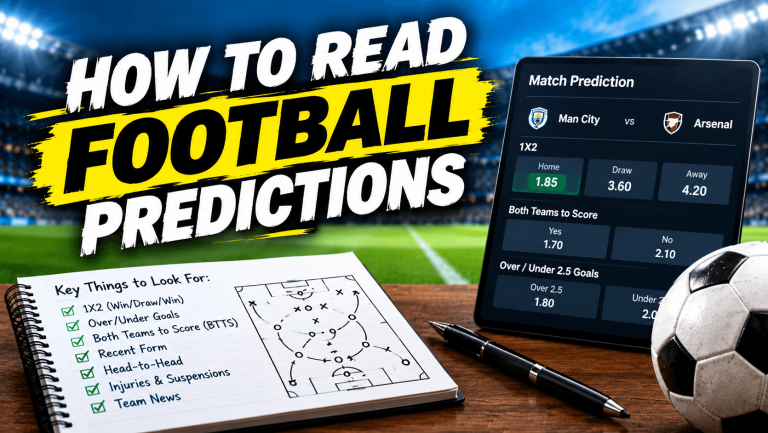

How to Analyze Football Predictions Before Placing a Bet

While it may be helpful to get some ideas for football predictions of future games, it is essential they are taken on their own merits and not without understanding it. The outcome of a match will depend on a team’s recent form, scoring record, defense, injuries and their tactics.
In football prediction analysis, all information about a match is taken into account, a team’s strengths are compared and it is determined whether there is evidence for a specific result. Football games can sometimes bring out the unexpected so it is not a guarantee that the prediction will be correct.
When you’re considering placing a wager on football predictions, there are a number of key things that you need to consider.In this guide, we’ll discuss the most important things to look at before wagering money on football predictions.
1. Study Each Team’s Recent Performance
A team’s recent record gives a first indication of the state of the team. But an analysis of just the number of wins, draws and defeats can often not clarify how good or bad the team has been.
Consider the following:
- Most up-to-date matches’ results.
- Goals scored and conceded!
- Consistency in attack and defence.
- The strength of previous opponents.
- Variations in performance from game to game.
For instance, a team might be 4-5 in their last five games, but may have played against weaker opponents in their last five games. It may be a lot worse vs a tough opponent.
Recent form is helpful, but should always be used in conjunction with other match statistics.
2. Compare Home and Away Records
Playing at home and playing away can present different challenges for football teams. A few are consistent when travelling to another stadium but don’t do as well when at their home base.
Prior to judging a match, review:
- Recent results of the home team.
- The away record of the visitors.
- Goals scored and conceded in those games.
- The number of games that neither side scored in.
- Results achieved v. peers of equal ability.
Such a comparison can show a trend that might not be apparent to an individual based on a team’s overall league standing.
But it’s not a rule that home teams will be the favourites. Both sides quality and current performance is still important.
3. Examine Attacking and Defensive Statistics
There are several important things to take a look at when analyzing a football match, and goals scored and conceded are among the most important.
If one team can score more often, they might be in an attacking position, and if the other team allows more chances to be on the defensive.
There are some statistics that are useful to look at:
- Goals scored – Indicates how often a team can put the puck in the net.
- Goals conceded: Helps assess defensive performance.
- Shots on target: Number of shots towards the goal.
- Clean sheets: Indicates how many times a team has kept the other team from scoring.
- Expected goals (xG): Estimates the quality of goal-scoring opportunities created.
- Expected goals against (xGA): An estimate of how good a chance conceded is.
Goal scoring can be given extra context without the final score. The team that scored one goal from several good opportunities, for instance, might have done things differently if it had scored one goal from very few opportunities.
There’s no single statistic that will tell the whole story. Compare the numbers of matches played across a few matches and take into account the level of opposition.
4. Check Injuries and Suspensions
Available players can have a huge impact on the preparation and performance of a team.
If an important striker is injured, this could impact attacking options, whereas the lack of a regular centre-back or goalkeeper could have an effect on defensive stability.
When making an acceptance of a prediction, check:
- Players currently injured.
- Suspended players.
- Doubtful players.
- Anticipated loss of earnings due to injuries.
- Suggested lineups for the beginning of the game.
A player’s importance varies depending on the game they play and the quality of the replacement(s).
In addition it is crucial to keep up the difference between confirmed team news and speculation. An expected lineup is not an officially confirmed lineup.
5. Understand the Tactical Matchup
However, the quality of the individual players isn’t the only factor affecting football games. The strategy that two teams use in a game can make either advantages or disadvantages.
For instance, a team pressing high up the pitch can make opponents make a mistake. But if the pressing is too aggressive, there can be space behind their press.
In analyzing a tactical matchup, keep in mind:
- How attacks are constructed by each team.
- If either side uses a counter attack.
- The strength of each team’s defence.
- Their ability to cope with pressure.
- If their playing style leaves them vulnerable to the opposition.
Knowing these things can help to clear up why a team can be losing to a certain opponent, despite their recent record.
6. Don’t overlook past meetings, as they can be informative.
Head to head record is the statistics of the performance of two teams in previous games.
These results can show up trends, including close games, lots of scoring, or a regular dominance by one team.
But, past bets are no dependable indicator of the next one. There is a time element where managers, players, formations and strengths can vary greatly over time.
Focus more on recent and relevant meetings, especially if teams have been playing more or less the same game and the players are the same.
7. Understand the Betting Market and Odds
You can’t make any sense out of a football prediction until you grasp the market that goes with it. The match conditions differ for different markets, and will yield different winning selections.
There are several common football betting markets that are used:
- Match Result (1X2): Forecasting whether a match will finish in a home win, draw or away win.
- Over/Under Goals: Guessing if the number of goals scored will be higher or lower than a number you’ve set.
- Both Teams to Score: Is it possible for both teams to score a goal?
- Double Chance: Chosen 2 of 3 possible outcomes of a match.
By understanding the market, you can gauge whether the statistics that support the prediction are relevant to the market.
The way to read betting odds.
Decimal odds represent the winnings that might be won on a winning bet, plus the original bet.
This formula can also be used to transform them into implied probability:
Implied Probability = 1 / the decimal odds x 100
For instance, 2.00 is an implied probability of 50%.
This is not to say that there is a 50% likelihood of this occurring, but only that it has been observed to occur 50% of the time. Odds may include the margin and can be found in the price being offered by the bookmaker.
8. Examine the Reason Behind Every Prediction
A good prediction is accompanied by an explanation. If someone just says that a team is going to win, that doesn’t give much information to the readers so that they can make the selection.
When searching for analysis, search for an explanation that provides:
- Explanation of why the team is considered competent.
- What data are used to make the prediction.
- How the opponent’s weaknesses can affect the game.
- Availability of key players.
What might prevent the prediction from being accurate.What might hinder the prediction from being correct.
Beware of predictions that are made based solely on popularity, reputation, or recent winning streaks.
A convincing analysis should give reasons for the evidence and potential weaknesses of the analysis.
9. Evaluate the Reliability of Prediction Websites
Not all football prediction sites offer the same type of analysis or transparency.
Check out the way a prediction platform displays and documents its picks before using the platform.
There are important items to look at:
- Whether predictions are before or after the game.
- Which of the selections mentions its betting market?
- If the win or loss is recorded or not.
- If historical results are reported properly.
- If the accuracy figures do not include all settled choices.
- Does the platform provide an explanation of its prediction techniques.
The accuracy of the prediction can be computed from:
>> Prediction Accuracy = (Correct Predictions / Settled Predictions) × 100
For instance, a platform that makes 70 precise forecasts out of 100 wagers has a 70% precision measure.
But just because it’s accurate doesn’t mean that a betting strategy will be profitable. The odds, the stakes and the outcome of all of the picks are also important.
10. Avoid Common Football Prediction Mistakes
With the information provided in a match, if it’s there, too much may be interpreted as not being enough, or the reverse.
Don’t commit these errors:
- However, if they are solely based on recent victories, a winning streak does not necessarily lead to more wins.
- Not considering Player availability: The team’s strength and approach can change as a result of not considering player availability.
- Overvaluing head-to-head records: Past games are not necessarily indicative of current team form.
- Playing the odds wrong: It does not necessarily mean that whatever has low odds is the guaranteed winner.
- Failure to take the opposition into account: A team’s strengths should always be measured against the opposition.
- Adding too many selections: If you have too many selections on an accumulator, it can be harder to win.
- Believing in guaranteed-win wagers: There is always a chance that you can lose when it comes to football wagering.
Careful analysis is to take account of the evidence without taking it for granted that anything is inevitable.
Conclusion
Going beyond the league position or recent winning streaks is necessary in order to analyse football predictions. This includes analysis of team performance, match statistics, home and away records, player availability and tactical difference analysis.
There is a certainty about football that can’t be overcome by these factors, but they can offer a better basis for assessing the potential of any match.
It’s the lesson that every football fan can learn at Tipstadium: of not only predicting a game but knowing the reasoning behind the prediction.
A well considered prediction is supported by relevant information, realistic expectations and a realistic awareness of risks.
Betting on football comes with risks. Don’t assume that predictions will come true or that they’re risk-free investments.